


Search Website
2026
May 2026
16th Annual European Union Study Abroad Program
Make sure to check out the 16th Annual European Union Study Abroad Program
May 3 - May 16, 2026
University of Windsor/Western University
Details about the program available below:
https://www.uwindsor.ca/political-science/361/eu-study-abroad-program
April 2026
Congratulations to our 2nd Annual IR Essay Prize Competition Winners!
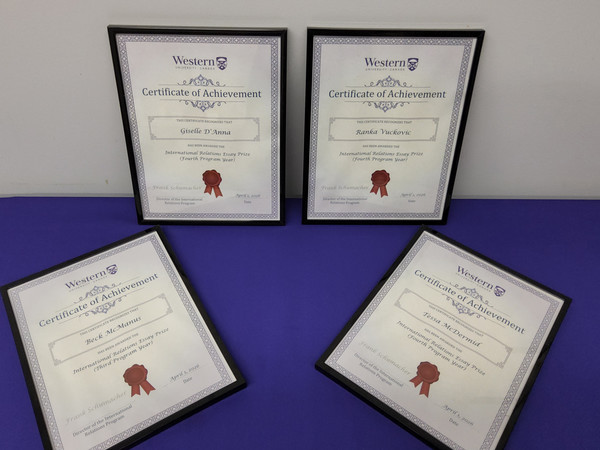
Congratulations to the winners of our 2nd Annual IR Essay Prize Competition on "Art, Speculative Futures, and International Relations!
We received outstanding contributions and are delighted to award the prizes to:
Giselle D'Anna (4th Program Year), Tessa McDermid (4th Program Year), Beck McManus (3rd Program Year), and Ranka Vuckovic (4th Program Year).
Remembering the Past for the Future (Tessa McDermid)
Speculative Criminals: Resisting The Pax Americana (Beck McManus)
The 51st State of Mind (Giselle D'Anna and Ranka Vuckovic)
Congratulations everyone - Well Done!
2nd Annual IR Essay Prize Competition
This year's IR essay theme is:
“Art, Speculative Futures, and International Relations”
- What is your reaction to the Pax Americana Exhibit at Weldon? What is/are your favorite plaques and book covers, and why?
- What can art tell us about IR and what are its limits? Can you imagine other ways of connecting art to the study of IR?
- How can the reflection on speculative futures enhance our understanding of IR? Can you give specific examples?
Applicants are recommended to explore the ‘Pax Americana Exhibit’ at Weldon Library, choose your 1-2 plaques favorite plaques and book covers and write an elegant, eloquent, and proof-read essay reflection of 800-1000 words. Imagine you work for a famous magazine and use the exhibit to address a question(s) from the above list.
The deadline is April 1 at midnight.
Please separate the title page from your information for anonymous review and submit your essay electronically to ir-inquiries@uwo.ca
There are six prizes of $100.00 each available – Two per program year!
The winners will also receive a certificate and be treated to lunch!
Good Luck!
March 2026
International Relations Reception Dinner - March 30, 2026
AIR (Association for International Relations) and the International Relations program warmly invite all registered IR students years 2 - 4 to attend the International Relations Reception Dinner, a special evening celebrating the end of the academic year and 20 years of the International Relations program.
Please join fellow students and faculty for an evening of celebration, reflection, and connection as we mark this important milestone in the history of the IR program!
Event Details:
When – Monday, March 30, 2026
Where -The Wave (in UCC)
Time – 6 – 8 pm
Dress code – Semi formal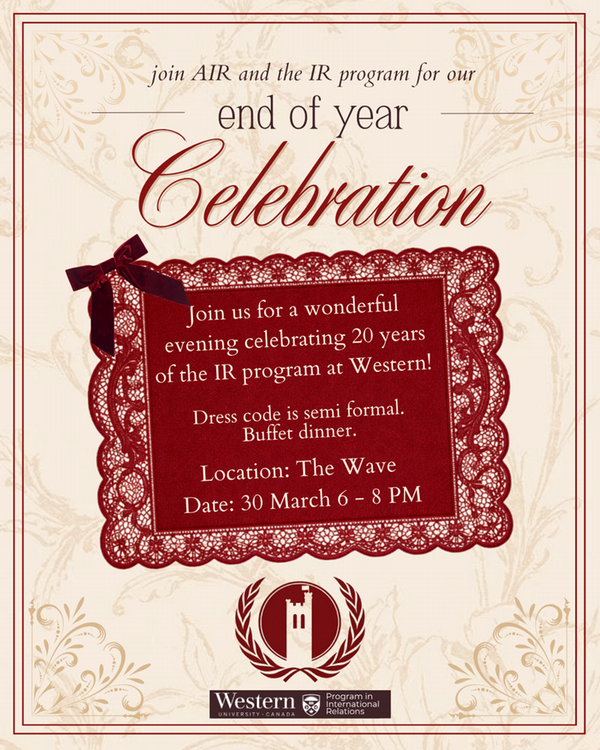
The reception is open to all registered International Relations students. A buffet style Italian dinner and refreshments will be provided.
Please RSVP by 11:00 a.m. on Friday, March 27, 2026 - HERE
SAGE-Funded History Symposium - "Anti-Western Narratives and the Crises of Global Order(s)"
Thank you to all participants who made our SAGE-funded History Symposium on "Anti-Western Narratives and the Crises of Global Order(s)" such a successful and enjoyable experience. We learned a lot from our conversations, discussions, and reflections. A special thank you to our presenters - We look forward to continue working with you on this project.
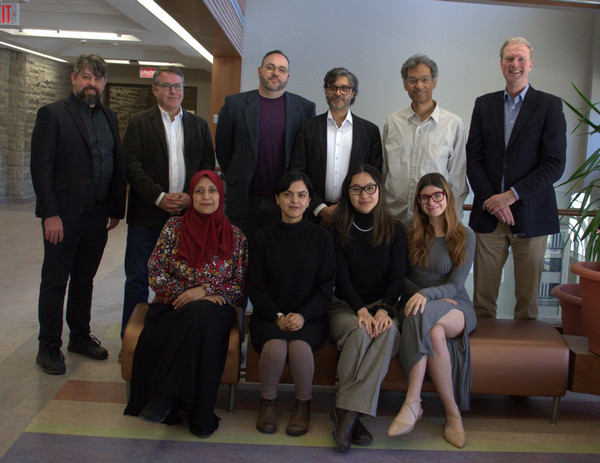
Front row: Sara Khorshid, Samra Khan, Helen Li, and Ranka Kyriakidou Vuckovic who served as rapporteur
Back row: Oleksa Drachewych, J. Paul Goode, Maurice Jr. Labelle, Amitava Chowdhury, Viren Murthy, Frank Schumacher; not featured Michael Kimmage who participated remotely
Final Bi-Weekly IR Coffee Hour - March 25, 2026 - Thank you!
On Wednesday, March 25, The final bi-weekly IR Coffee Hour was held - Thank you to all of our IR students who have attended this regular event throughout 2025-26!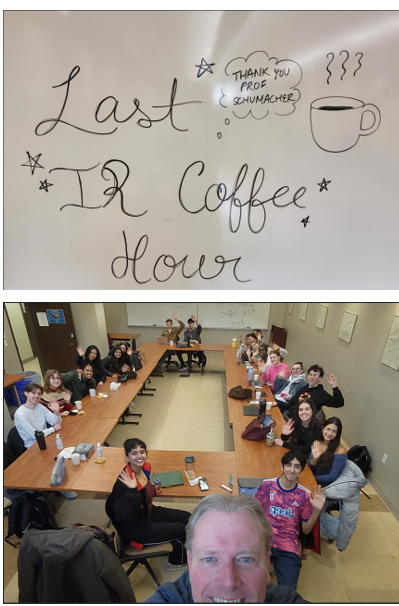
Professor Schumacher and IR students at the final IR Coffee Hour
Inside Pax Americana: This speculative art exhibit explores a world where Canada becomes the 51st state
(CBC Fresh Air interview by Ismaila Alfa, published March 14, 2026)
On Saturday March 14, 2026, CBC's Radio Program 'Fresh Air' featured Dara Vandor and Frank Schumacher who discussed the 'Pax Americana Exhibit' at Weldon Library and its significance to Western's International Relations Program with host Ismaila Alfa. The full interview can be accessed here.
For more on 'Pax Americana': https://www.daravandor.com/pax-americana-weldon-plaques.
The exhibit is currently housed at the D.B. Weldon Library, Western University and has been extended until May 9, 2026.
What would change if Canada became the 51st state? Just look at what's happening at Western University
In the exhibit Pax Americana, artist Dara Vandor imagines a future that doubles as a warning
(CBC Arts article written by Leah Collins, published March 10, 2026)
Last Monday, an art exhibit opened at Western University's D.B. Weldon Library, and before it was unveiled, user experience librarian Jennifer Robinson gave colleagues a helpful heads up. "I primed the staff," she says with a laugh. "You may get questions."
There'll be queries on the current status of U.S.-Canada relations, no doubt. The show, Pax Americana, is a collection of satirical book covers and historical plaques by Dara Vandor, a multi-disciplinary artist from Toronto. The text imagines a not-so-distant future; a Canada fully absorbed by a fascist United States. And to sow a deliberate degree of confusion, Vandor has installed the signs guerrilla-style amid the stacks.
At the entrance to the Archives and Research Collections Centre, for example, there’s a sign identifying the space as A Repository for Canadian Culture. (Holdings include an “assortment of hockey erotica and 10 issues of Chatelaine.”)
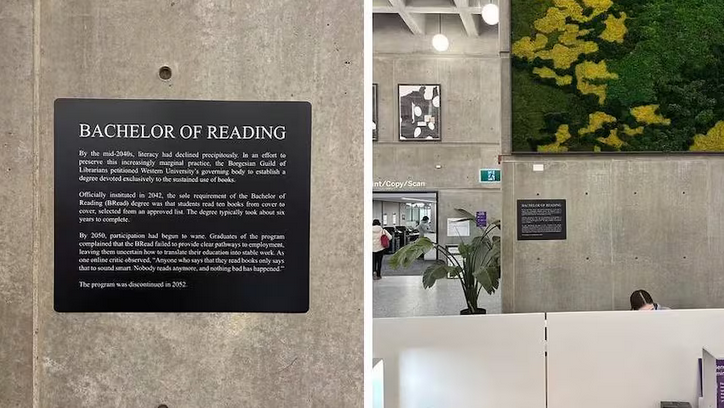
One of Dara Vandor's plaques exhibited in D.B. Weldon Library
Another aluminum plate, pasted on a window facing a courtyard, heralds the Philip Morris International Scrolling Garden, a “respite from knowledge and learning” established in 2041.
One of Robinson’s favourites, which hangs in Weldon’s grandest study hall, commemorates a short-lived degree program, the Bachelor of Reading. (To graduate, students must finish 10 approved books from cover to cover, a suggestion which would be laughably absurd if universities weren’t already offering courses in “reading resilience.”)
Robinson’s received positive feedback since the exhibit launched. A few colleagues were startled by the plaques, though they eventually remembered an all-staff memo about the event. Robinson’s initial reaction? “I laughed.” But the moment was shorter than a B. Read student’s attention span. “You sober up,” she says. “You know, these [signs] are pointing out some maybe dramatic but accurate pathways.”
The Weldon exhibit is an extension of a project Vandor began last March. Like many Canadians, she was shocked and angered by Donald Trump's casual threats of annexation. Vandor wanted to take action, but how?
Patriotic sloganeering was on the rise, but to her, the cries of “elbows up” and “buy Canadian” rang hollow. A sitting president was thinking out loud about redrawing the border. Was boycotting California strawberries — or loudly questioning the provenance of a double double — truly going to do anything?
“All this stuff was way too banal for what I was feeling,” says Vandor. “Canada could easily disappear.” And so, she got to work.
“I wanted to create a series that imagined this alternate reality and confronted people,” she says. This is what life in Trump’s 51st State could look like.
Her first piece set the tone: an aluminum plate in the serious, unadorned style of Toronto heritage plaque. The text described the victory of “United States Patriot liberation forces.” On Aug. 11, 2031, “Canadian irregulars” surrendered on this spot. She hung the marker in an alley near her home.
One didn’t feel like enough to Vandor, so she made another, and another — and for the next nine months, often with her baby in tow, she toiled in secret as a one-woman department of civic monuments. (None of the original plaques remained up long, though she sells reproductions online.)
On Vandor’s website, she’s collected photos of all the plaques, and they read as a chronological saga. In this future history, Ivanka Trump is president, Alberta was “liberated” in 2027, Canadian insurgents “spread misinformation” at the Trinity-Bellwoods tennis court and the old MuchMusic building has been re-opened as 51st Productions - Stage One, home of popular state-sanctioned fare including Mel Gibson’s Anne of Green Gables.
Vandor describes her writing process as “very improvisational jazz.” She hasn’t sketched out a plot. “The core nugget was just this idea of would Canadians fight? Would they be interested in picking up arms and standing up for our country?,” she says. “I didn't have this grand narrative from the beginning.” A few details are canon, however, with events transpiring before and after Aug. 27, 2035 — or Unification Day, the date of Canada’s official absorption into the union.
Beyond Toronto, Vandor has left plaques in Tofino, B.C., Ottawa and Montreal. “I wanted to expand as much as possible,” she says, and in October last year, the idea for an exhibit was sparked.
That month, while speaking at Western University, Vandor connected with Frank Schumacher, a professor of history and director of Western’s international relations program. The professor was impressed by Pax Americana, especially its ability to bend the viewer’s sense of reality.
Finding one of Vandor's plaques in a familiar place is a shocking experience, he says, and he wanted his students to experience that thought-provoking jolt for themselves.
Speculative fictions such as Pax Americana can be an opportunity to think creatively about thorny international issues, Schumacher explains. “It gives the students a vantage point from which they can explore an existential question, but they can do it within the safety of something imagined,” he says. “It doesn’t have to be [this way]. It’s not happening yet.”
Schumacher had never organized an art exhibit before, but he connected with Robinson at the D.B. Weldon Library about securing display and exhibition space. Robinson was a fan of the project right away. Upon viewing Vandor’s work, its timeliness was apparent. Her colleagues in the United States were already grappling with defunding and censorship, and changes to the Library of Congress have an impact on catalogue systems elsewhere, including here in Canada. For example, anything about the “Gulf of Mexico” must now be filed as “Gulf of America.”
“We are seeing the impacts and then sort of wondering, ‘OK, what would happen here?’” says Robinson. “Libraries really help support and uphold values that enable democracy. And so when those things start to erode and they sort of erode quietly, I'm not sure if people notice. … This felt like an opportunity to be like, well, what could we do to put this in front of more people?”
For the exhibit at Weldon, Vandor created 20 original plaques for the space. They can be read on their own or as part of the larger narrative she began spinning in Toronto, though many of the new episodes are eerily close to contemporary life, with or without the context of American expansionism. One plaque commemorates Robert F. Kennedy Jr.’s Brain Pyramid, which “ranks fields of study according to their national utility.”
Creating stories inspired by the library was an exciting exercise for Vandor. The first volume of Pax Americana asked whether we would fight for our country, and envisioned what would change if our borders were erased. The series at Weldon widens the focus. Our national sovereignty is as fragile as democracy itself. What do we lose when knowledge and freedom of information is devalued?
“This building allowed me to add a whole other layer to this series,” says Vandor. “We’re seeing a lot of censorship, a lot of control of information and opinion … And I don’t think it’s an American problem. It’s also happening on our side of the border.”
In producing the exhibit’s plaques and books — which include “corrected” editions of Call of the Wild and Sunshine Sketches of a Little Town (“Now set in America!”) — Vandor worked with Robinson in selecting where to place the signs, and though visitors can request an exhibition guide in the lobby, the work is intended to be a sort of interruption.
“I really wanted it to be a scavenger hunt,” she explains. “This is a series that is about all of us, about our collective future and our collective present, and what world we are building.”
At Weldon, Robinson has noticed students eyeing Vandor’s work with curiosity. So far, none of the plaques have been pried off the wall to become dorm-room decor, but if anyone has questions about the exhibit — the feasibility of Albertan secession or whether undergrads are truly reading less than ever before — well, they’re in the right place to research the answers.
“Libraries should be spaces where you're confronted by uncomfortable ideas and libraries should be spaces and places where you can then explore, well, is this true?” says Robinson. “I hope [Pax Americana] might inspire people to ask, well, where could I learn more about how to avoid this situation?”
The exhibit will be housed at the D.B. Weldon Library, Western University until late April 2026.
Western IR & AIR 3rd Annual Career Workshop:
"From Classroom to Conflict Zone to Courtroom: The Reality of Prosecuting International Crimes"
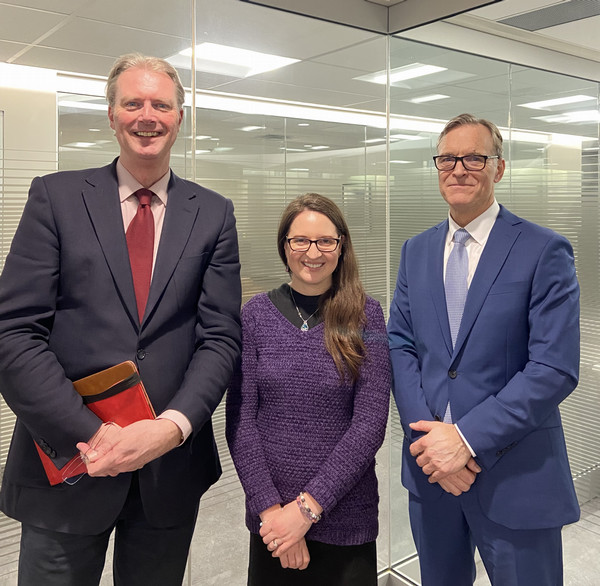
(left to right) Frank Schumacher, Lauren Newman and Norman Farrell
On March 5, 2026, the IR program was very fortunate to host Norman Farrell, one of the most experienced prosecutors of war crimes and genocide, for our 3rd Annual IR Career Seminar.
"From Classroom to Conflict Zone to Courtroom: The Reality of Prosecuting International Crimes" was an exceptional experiential learning opportunity for our students. Thank you all for spending time and discussing this important work with us!
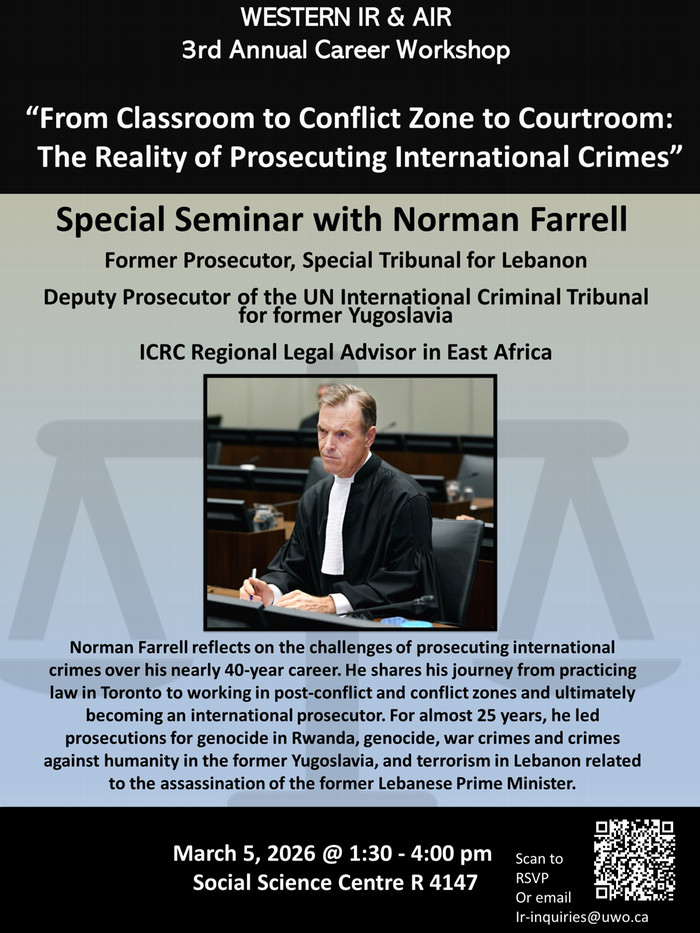
Our latest IR & AIR Career Workshop will be featuring international prosecutor Norman Farrell. During this seminar, Norman will reflect on his nearly 40-year career and the challenges that have come with prosecuting international crimes during that time. He will be sharing details about his journey, from his years practicing law in Toronto, to working in post-conflict and conflict zones, up to his more recent years working as an international prosecutor.
What if Canada became the 51st state? This artist imagines what that future looks like
Dara Vandor’s Pax Americana installation explores annexation and fragile sovereignty
(CBC article written by Josiane N'tchoreret-Mbiamany, published March 4, 2026)
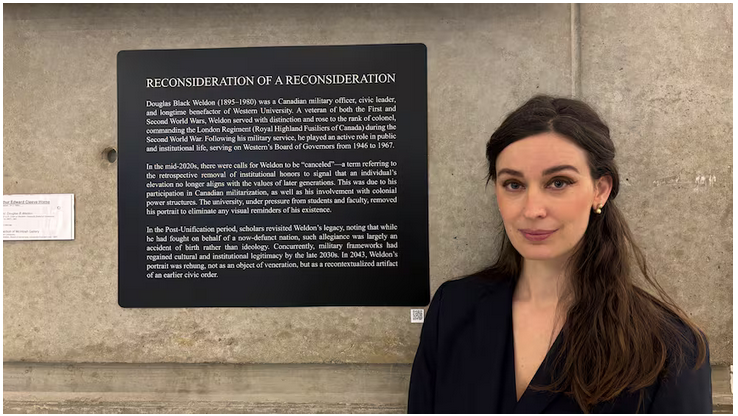
Artist Dara Vandor stands beside one of her fictional historical plaques installed at Weldon Library
Backpacks thud onto tables. Chairs scrape against the floor. Students weave through a university library in London, Ont., eyes on laptops and coffee cups.
Across the room, a black plaque catches a few eyes. It looks official, like an historical marker explaining what happened in a place. But this one is imaginary.
It describes a future where Canada has been annexed by the United States.
“I wanted people to feel it,” Ontario artist Dara Vandor said of her Pax Americana exhibit. “I wanted them to think about the actual reality, not just the strawberries.”
Vandor created 20 plaques now installed throughout Western University's Weldon library as part of the speculative art series. She launched it in 2025 after President Donald Trump repeatedly suggested annexing Canada.
The plaques are written as if annexation has already happened, inviting viewers to consider how history is recorded and who gets to define it.
Vandor said she was concerned Canadians were not taking the comments seriously.
“After an initial shock, Canadians started to worry about really small things, like where they would buy strawberries from in California, and if they were allowed to go to Disney World anymore,” she said.
“I just felt that these concerns were so small in the face of this much larger threat that we could lose our country and lose our values and lose our nationhood.”
The idea started with a single plaque in her Toronto neighbourhood.
“I was just going to do one,” Vandor said. “And then one became two, and the ideas just started to spiral.”
Since then, plaques from Vandor’s series have appeared in cities across Canada, including Toronto, Ottawa, Montreal and Tofino.
The plaques are engraved on a material known as dura black, designed to withstand weather and wear.
“I think it’s that quasi-official feeling of a plaque ... it’s engraved, and it’s done, it’s settled,” she said. “I wanted people to think about how history is so mutable. It’s cheesy, but history is written by the victors.”
The project caught the attention of Frank Schumacher, a professor of history and director of international relations at Western University.
“What struck me was that it was a combination of eerie realism and playful imagination,” he said. “Putting up landmark signs about a U.S. invasion of Canada, that’s bold.”
He invited Vandor to bring the series to Western University, saying the installation offers students a different way to engage with questions about politics and power.
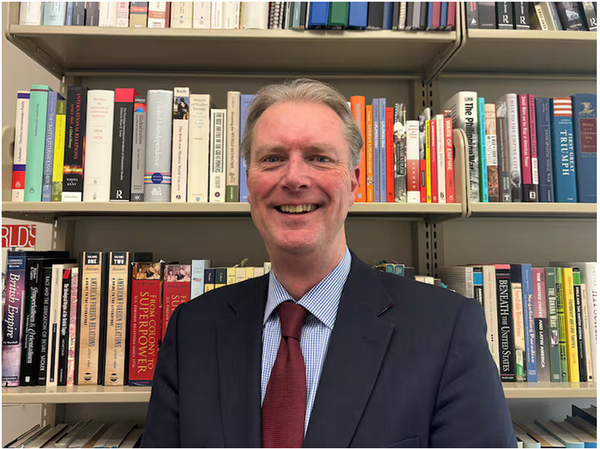
Professor Frank Schumacher
Schumacher said university students are often focused on producing concrete answers to current crises.
“Speculative art is free to speculate,” he said. “It can tackle questions that a scholar might not even consider.”
For him, the plaques are less about predicting the future and more about examining how nations understand themselves in moments of uncertainty.
“We wake up and there is a new crisis somewhere,” he said. “Art like this gives us a moment to step back and think differently.”
The plaques have drawn a wide range of responses, exactly the kind of engagement Dara Vandor hoped for.
In the early days, some questioned whether she had a permit to install them. More recently, she said she has received messages accusing her of pushing a hidden political agenda.
“It really runs the gamut,” she said. “If it provokes an emotion, I’m happy.”
For Vandor, the backlash and debate signal that the work is functioning as intended. She does not see the plaques as instructions or predictions, but as invitations to reflect.
“That’s what makes art, art and not a manifesto or a government decree,” she said. “It’s meant to be seen in many different ways.”
Frank Schumacher agrees. He said the plaques give viewers space to form their own conclusions.
“They can see it, they can agree with it. They can reject it,” he said. “They can use it as something that inspires them to think differently about the world.”
Still, Vandor does not shy away from the unease embedded in the series. She argues that discomfort can be productive.
“Maybe it should normalize the fact that our neighbours might not always be peaceful,” she said. “The ease at which Canada exists in the world should not be taken for granted. So yes, let’s put a little bit of fear in people and use that fear to make something constructive.”
Art, Architecture & Speculative Futures in International Relations
When – March 2, 2026 from 5:30 – 8 pm
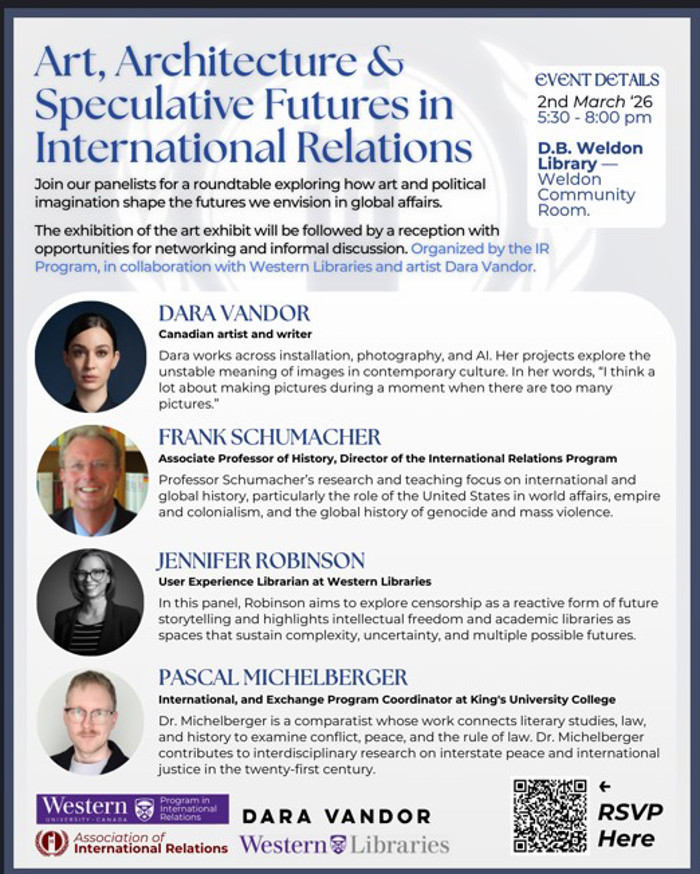
Join our panelists for a roundtable exploring how art and political imagination shape the futures we envision in global affairs. The exhibition of the art exhibit will be followed by a reception with opportunities for networking and informal discussion. Organized by the IR Program, in collaboration with Western Libraries and artist Dara Vandor.
February 2026
America Has Occupied Canada, in the Creative Mind of a Toronto Artist
(New York Times article written by Shawna Richer, published February 28, 2026)
A speculative public art series that began in alleyways and on buildings and a tennis court fence is opening as a chilling new show at Western University.
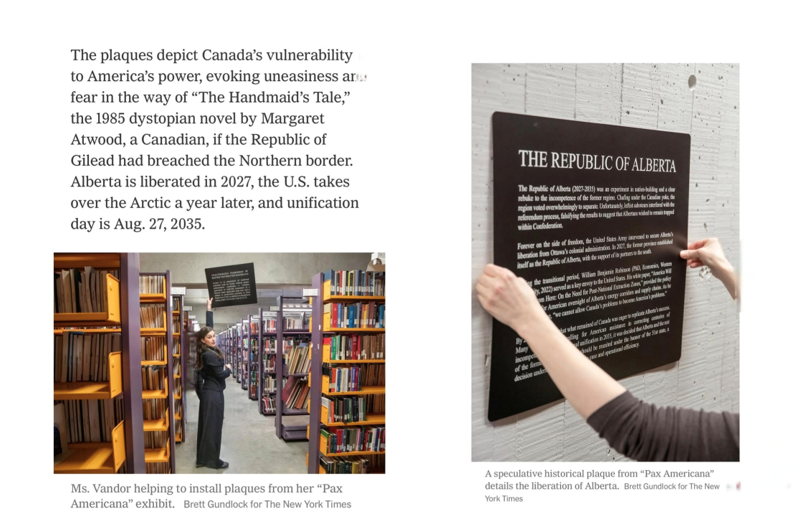
(left to right) Artist Dara Vandor in D.B. Weldon Library, Jennifer Robinson (Weldon Librarian), assisting with the installation of the exhibit. Photos taken by Brett Gundlock
The full article can be accessed here.
WAFAR Summer Research Internship Opportunity - Focus on Arctic Sovereignty
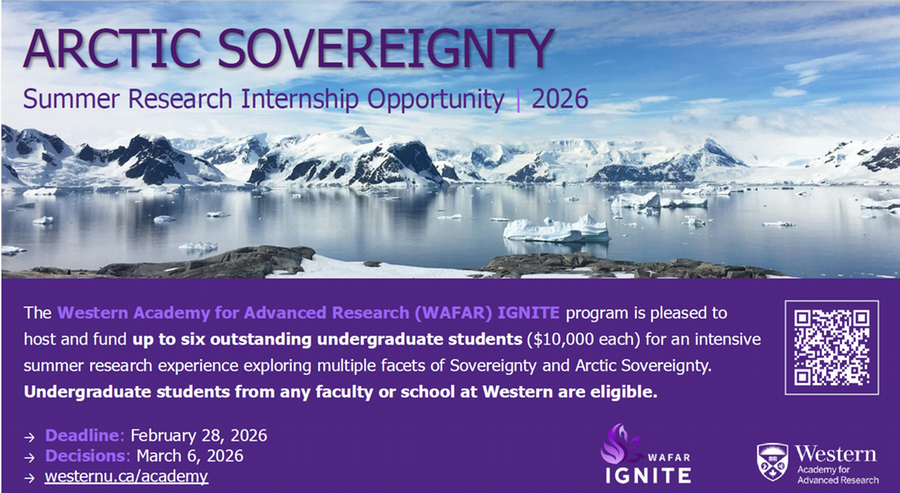
Deadline for applications is February 28, 2026.
Further details about this opportunity can be found on the here:
https://www.uwo.ca/academy/themes/Arctic_Sovereignty.html
Council on Foreign Relations Summer Internship
The Council on Foreign Relations Summer Internships are now open for applications!
This is an outstanding opportunity for IR students!
The application deadline is February 8, 2026. For more Information, please refer to the Council on Foreign Relations' website:
https://www.cfr.org/career-opportunities/internships
January 2026
'New world order' brings politics out of textbooks for these university students
(CBC article written by Isha Bhargava, published January 22, 2026)
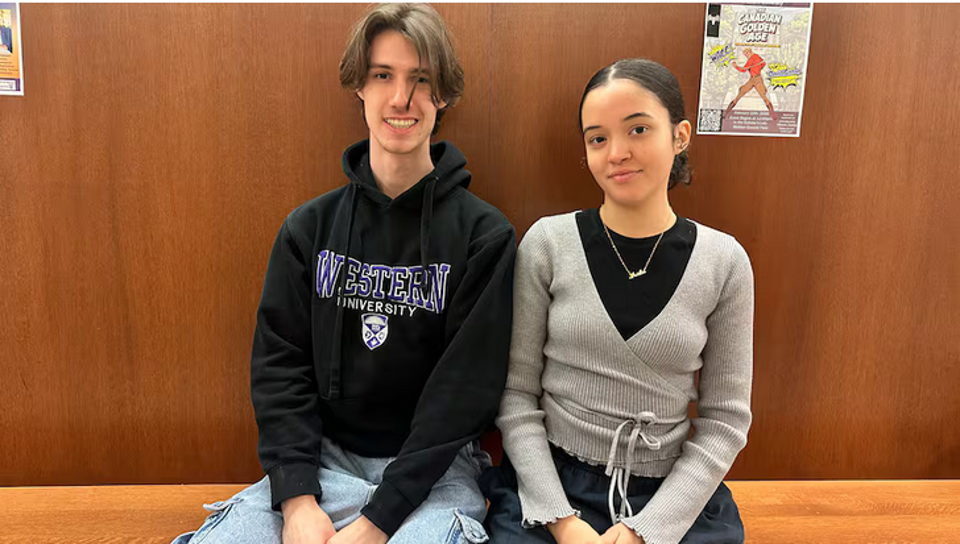
Keeping up with the rapidly evolving dynamics of geopolitics can feel exhausting these days.
There was U.S. President Donald Trump wanting control of Greenland, threatening tariffs against his allies, and Prime Minister Mark Carney's provocative speech about a shakeup of the global order at the World Economic Forum in Davos, Switzerland, all of which has happened this week.
But for some university students majoring in politics, the constant twists and turns have made textbook lessons come to life and forced them to apply theories to the changing world they live in.
"It's super overwhelming! I'm a little tired of waking up to unprecedented things," Finlay McFarlane, a third-year international relations student at Western University in London. Ont., said.
"As a young person and someone who's going to have to live in that 'New world order', this is frightening," he added referencing Carney's speech.
At the same time, the current political situation is shaping course work and how students engage academically, McFarlane said. He points to a history of genocide course he's taking where a hypothetical U.S. annexation of Greenland was among first topic of discussion.
It's something McFarlane, a dual American and Canadian citizen, couldn't imagine as a real possibility a few years ago. His peer Maria Maia agrees, adding that watching the world order change so quickly has been concerning.
"This brings more uncertainty, whether positive or negative," Maia said, who's in her third year of a political science degree. "It changes things and we can't predict them. And that makes it scary."
Maia believes this change in structure was inevitable and had built up over the years, she said.
"I think it's important as students of this discipline to know that we have to adapt to these issues. This isn't something brand new, international law and relations are so trust-based," she said, adding that it's difficult to see how the structure of the world can be changed by someone like Trump, who holds a hegemonic power.
Educators are also actively trying to wrap their heads around the changing landscape when it comes to teaching courses about international relations, Blair Welsh, an assistant professor of political science at Western, explained.
Students are bringing up concerns and conversations about Canada safety and hypothetical scenarios about its participation in wars, Welsh said. Last semester, many students spoke about travelling to or buying products from the U.S.
"It's definitely bringing up more questions than answers and we're now engaging in much more in-depth discussions for things that are changing on a day-to-day, week-by week basis," he said.
"You design a syllabus in advance and you think that we will run through these topics very naturally. But because of the way international relations are being reshaped, if you ask me what kind of conversations I expect to have by the end of the semester, I wouldn't be able to predict it."
Welsh has found a growing number of students from other departments are taking political science courses to learn more about it and the role they play in geopolitics.
Maia and McFarlane have also noticed more students becoming politically engaged. They believe it's a result of heightened awareness due to multiple global conflicts that are impacting communities in Canada, along with an influx of information online.
Many students walking by demonstrations happening on campus are asking questions and having discussions even if they're often polarized, said McFarlane.
"A lot of people would typically just ignore politics, but with the gravity of things and mass atrocities happening across the world, it's so in your face that you can't ignore it." he said.
Returning for the Winter 2026 semester…the Bi-Weekly IR Coffee Hour!
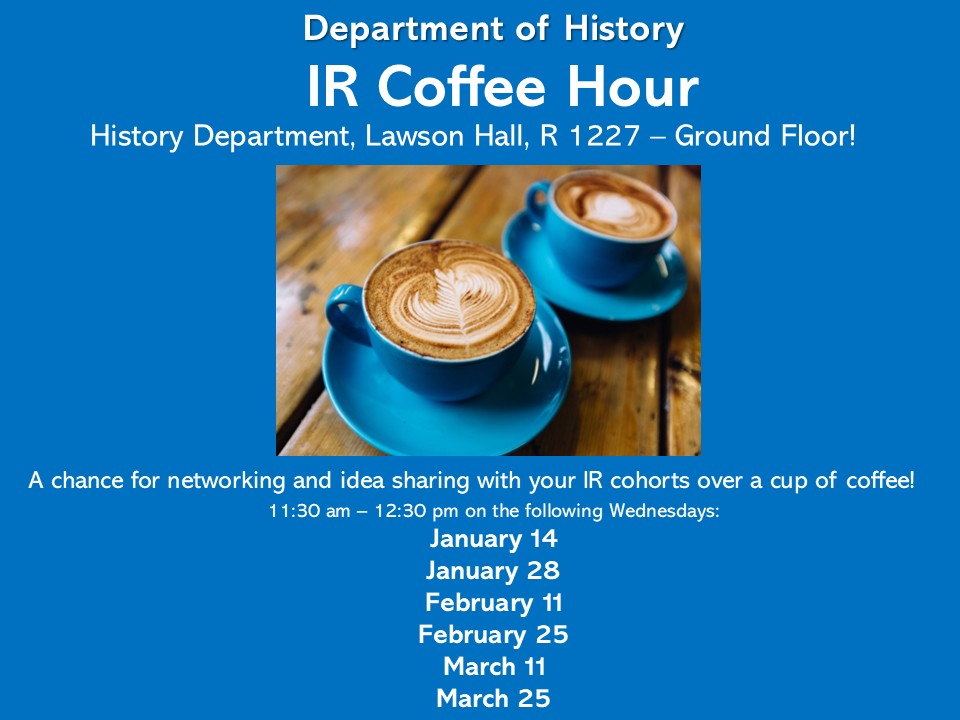
Throughout the Winter 2026 semester, The History Department will again be hosting our regular bi-weekly IR coffee hours on Wednesdays 11:30-12:30 pm, to allow for the continued networking and sharing of ideas and experiences with your cohorts within the IR program!
We invite all IR cohorts to join Frank Schumacher, the Director of the IR program, for a cup of coffee!
Bring your mug, we'll bring the coffee and snacks!
Where?
History Department, Lawson Hall 1227 (new location - ground floor!)
When?
Bi-weekly, Wednesdays, 11:30 -12:30 pm:
January 14
January 28
February 11
February 25
March 11
March 25
All of us in IR wish you a good semester, and we look forward to seeing you all at the next coffee hour, 11:30-12:30 pm, Lawson Hall 1227!